There are stones you can replace. And then there are stones that may never come out of the earth again.
That is something I learned early in this business. When you are working with American turquoise from a mine that has slowed down, closed, or disappeared entirely, every piece of rough carries a responsibility. Once the saw touches it, there is no putting it back together. Every cut is a decision about what will be preserved, what will be revealed, and what will be lost. That is why finding great turquoise has only ever been half of the work. The other half is finding the people you trust to cut it.
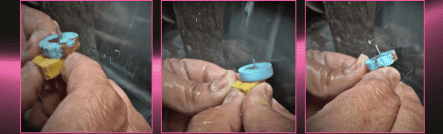
The Hands Between the Mine and the Artist
I have spent a lifetime building relationships with some of the finest stone cutters in the world.
Those relationships were not established through a price list or a few good orders. They were built over years of watching how someone approaches a stone. Do they study it before they cut? Do they understand the material? Can they see where the color is moving, where the matrix tells the story, and where the stone may be vulnerable? Are they trying to force every piece into the same shape, or are they listening to what each stone is capable of becoming?
The best cutters do not begin by asking, “How many cabochons can I get out of this?”
They begin by asking, “What is inside this stone?”
The difference between those views is enormous.
A skilled cutter can take an extraordinary piece of rough and reveal everything that made it extraordinary in the first place. An impatient or careless cutter can take that same stone and grind away the color, lose the pattern, weaken the structure, or turn something irreplaceable into something ordinary.
High-quality stone deserves highly skilled hands.
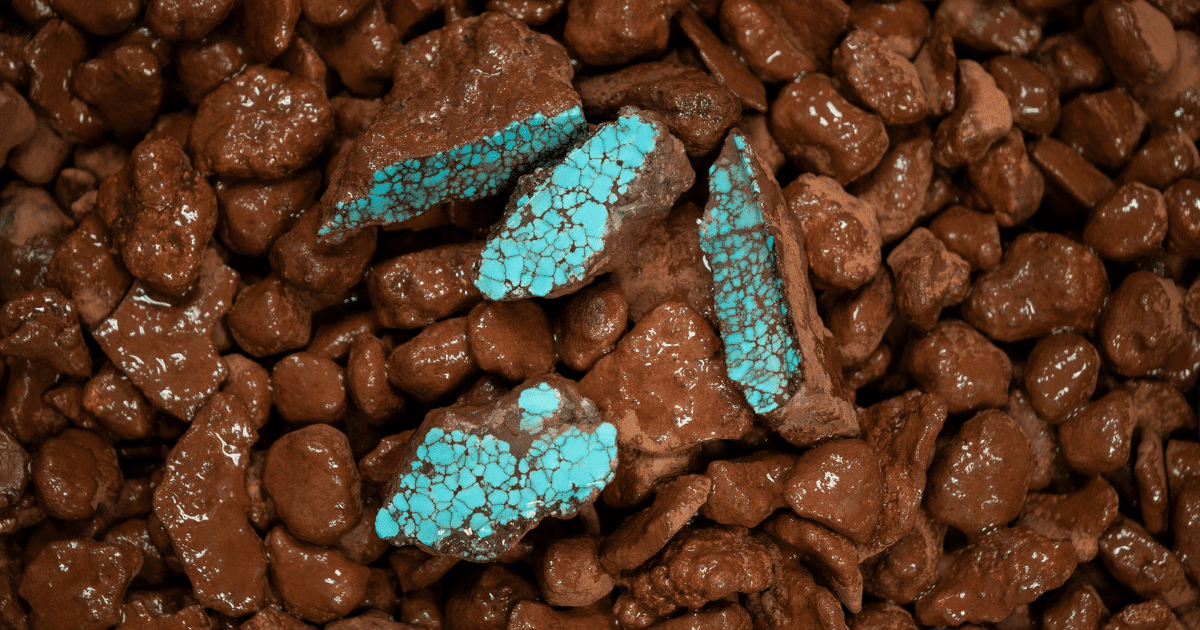
Prince Turquoise
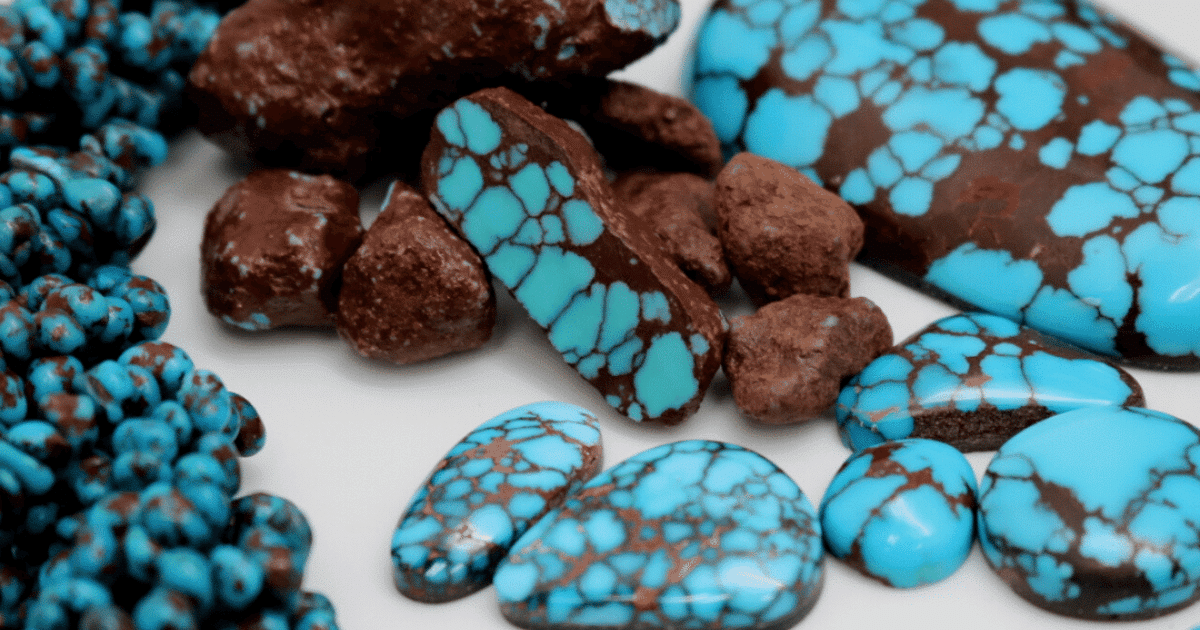
Every Stone Has a Face
Turquoise is most commonly cut into a cabochon – a polished stone with a rounded or domed face and a flatter bottom that can be set into jewelry. But that simple definition covers an enormous range of possibilities.
A cabochon may be round, oval, square, rectangular, triangular, teardrop-shaped, or completely freeform. It can have a high dome that gives the stone presence and depth, or a low dome that sits closer to the silver. Some stones are cut with broad, smooth faces to show their color. Others are shaped around a web of matrix that deserves to remain visible.
There are calibrated stones cut to consistent dimensions, which allow an artist to work from a planned design. There are matched pairs and suites, where the cutter must balance color, matrix, shape, and proportion across several stones. Then there are one-of-a-kind freeform cabochons that ask the silversmith to build the piece around the stone itself.
None of those approaches is automatically better than another.
The question is whether the cut respects the material and serves the art it will eventually become part of.
A great cutter does not merely produce a shape. They find the stone’s face.
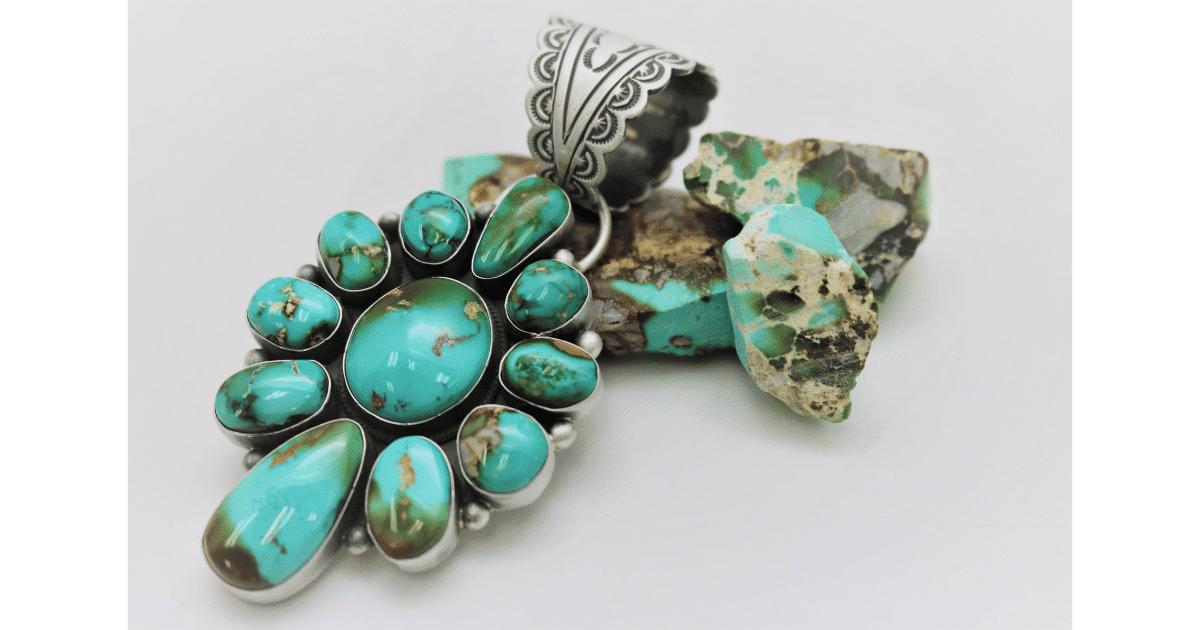
Royston Turquoise
Cut Stone and Rolled Stone
Not every piece of turquoise becomes a cabochon. Some material is rolled or tumbled, allowing motion and abrasion to gradually soften its edges and create rounded, “rolled” forms. They may become nuggets for necklaces, beads, accents, or designs that call for a more “hand shaped” feel. A cut stone is approached in a different way. The cutter selects its face, follows or redirects its outline, controls its dome, and decides how the pattern will sit inside the final form. Cut stones generally give the artist more control over how the stone will be set and how it will participate in the composition. Rolled stone and cut stone speak differently. One preserves more of the stone’s natural unpredictability. The other reflects a closer collaboration between the material and the person shaping it. Both can be beautiful when the process fits the stone and the finished piece. What’s important is not to assume that every piece of turquoise should be treated the same.